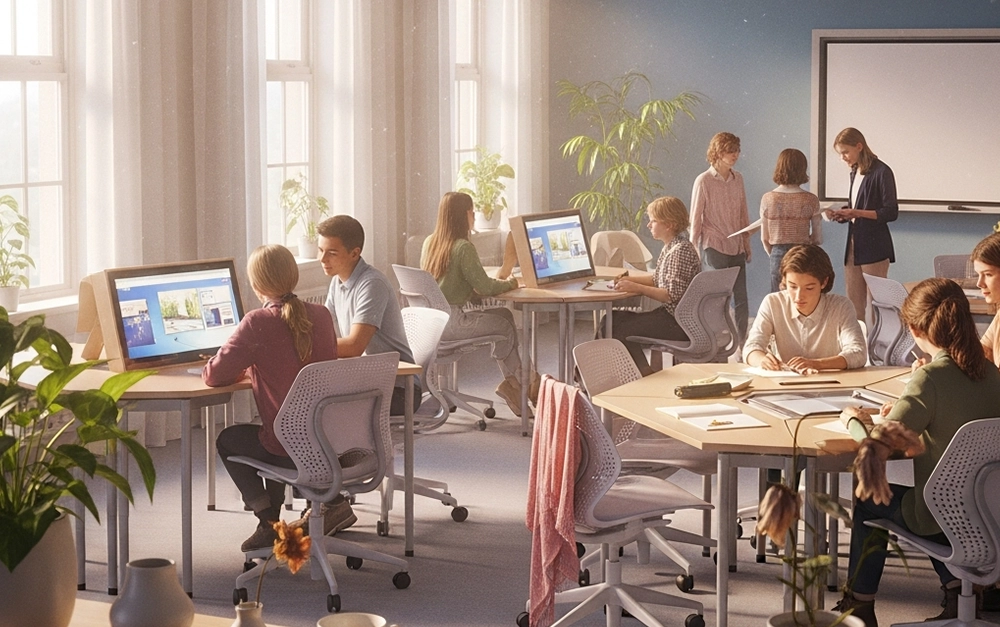
Across the country, school districts are moving beyond traditional renovation models and reconsidering space through a strategic lens. The guiding question is shifting from “How do we modernize?” to “How should space function within a learning ecosystem?” Modern school design is not simply an architectural project. It is a systems initiative that affects instruction, school culture, accessibility, operations, and wellness.
RFP SchoolWatch recently met with Sarah M. Rich, a consultant whose expertise spans systems design, professional development, and learning-environment strategy. Her perspective reinforces a critical principle found across design research: the success of any architectural initiative depends on the plan that precedes it.
Sarah M. Rich is an educator with 20+ years of experience in innovative learning. Ms. Rich is an expert in student-centered learning who has enhanced education in elementary classrooms through the high school level. She was a founding faculty member at Paul Cuffee School in Providence, Rhode Island. Previously, Sarah worked as Executive Director of Learning Innovation for ASU Prep. Here, she led a team that transformed their K-12 schools. Ms.Rich serves on the board of the Association for Learning Environments (A4LE) Northeast Chapter and is the President-Elect. Committed to A4LE’s core purpose of strengthening learning for all through better environments, she collaborates with interdisciplinary professionals to drive the evolution of learning spaces at the intersection of education and place.
Key Terms
| Term | Definition | Interpretation |
|---|---|---|
| Learning Space | A physical environment curated to support instruction, collaboration, and student well-being. | Helps teams distinguish between aesthetic upgrades and purpose-driven environments aligned to pedagogy. |
| Empathetic Design | A human-centered approach emphasizing user experience, emotional context, and lived reality. Rooted in IDEO principles. | Ensures spaces are shaped around real student and teacher needs rather than assumptions. |
| Design Thinking | An iterative framework of empathizing, defining, ideating, prototyping, and testing. | Supports continuous refinement of space based on stakeholder insight and evidence. |
| Systems Strategy | A coordinated plan aligning pedagogy, operations, technology, and design into a unified whole. | Prevents fragmentation across vendors and project phases. |
| Iteration | Revisiting and refining design choices based on user feedback and post-occupancy evaluation. | Continuous refinement of design choices based on user feedback and post-occupancy evaluation is crucial. This process ensures that learning spaces evolve with instructional models and student needs, rather than remaining static. It is this ongoing evolution that keeps the design relevant and effective. |
Let Strategy Lead
Research shows that students experience measurable benefits, greater engagement, stronger motivation, and deeper collaboration when learning spaces are intentionally aligned to pedagogy (EDUCAUSE, 2021). However, design alone is not enough. Visual appeal without functional alignment has little impact on student learning or school climate. This work encourages districts to begin with the lived experiences of students, teachers, and staff. This approach, influenced by David Kelley and IDEO, emphasizes that meaningful design begins with empathy. Design thinking starts with understanding what users actually need, prefer, and struggle with, rather than assuming what a space should be.
In schools, this may reveal challenges invisible in construction documents: sensory overstimulation, poor sight lines, acoustics that undermine instruction, transit bottlenecks, or inadequate space for small-group instruction. These insights guide the district toward a design that supports the instructional core.
The Systems Strategy Behind Learning-Space Design
Modern school design requires a systems viewpoint. Pedagogy, architecture, technology, operations, wellness, and culture function together in tightly interdependent ways. When districts consider these components in isolation, the built environment often fails to support instructional priorities. When they are considered in tandem, space becomes a partner in learning rather than a backdrop. A systems strategy acknowledges the relationships among:
- Pedagogy: Instructional models, grouping patterns, and teacher movement.
- Architecture: Spatial layout, natural light, acoustics, and visibility.
- Technology: Device integration, AV capabilities, and digital workflows.
- Furniture & Furnishings: Mobility, ergonomics, durability, and inclusion.
- Operations: Custodial rhythms, storage, transitions, and supervision.
- Wellness: Noise levels, air quality, sensory supports, and access to daylight.
Research reinforces the influence of these factors. Davidesco et al. (2021) found that student physiological synchrony, a measure linked to engagement, was significantly higher when learners sat in collaborative proximity rather than in isolated rows. This finding illustrates a larger truth: spatial configuration is not cosmetic. It shapes learning interactions at a neurological level.
Cross-Industry Collaboration
School-space projects involve a wide range of industries, each with its own priorities and technical language. Architecture and engineering firms manage spatial plans. General contractors oversee construction. Lighting and flooring companies address sensory and functional conditions. Furniture manufacturers shape movement, grouping, and accessibility. AV/IT integrators determine how technology supports instruction. Special-education and accessibility specialists ensure the environment is usable for diverse learners.
Without an early strategy, misalignment emerges quickly. Lighting choices can conflict with AV display visibility. Flooring or ceiling materials can undermine acoustic goals. Furniture layouts may contradict behavioral-support structures or small-group instructional needs.
Ms. Rich’s systems-consulting approach helps districts avoid this fragmentation. By grounding each vendor’s work in a unified, human-centered instructional vision, she helps teams maintain coherence from concept through implementation.
Strategy in Motion: From Concept to Reality
When districts begin with empathy-driven discovery, including interviews, observations, and stakeholder walk-throughs, they construct a foundation that guides each subsequent decision. This strategic arc continues through visioning, prototyping, architectural planning, construction, and post-occupancy evaluation. The audience, as integral stakeholders in the design process, plays a crucial role at each stage, thereby empowering them and making them feel more connected to the project’s success.
Districts that evaluate space after students and staff return, test acoustics, observe transitions, and gather teacher impressions create a cycle of continuous improvement. This mirrors the iterative philosophy at the heart of IDEO’s methodology: design should evolve based on evidence, not assumptions. This continuous improvement cycle not only ensures that the design remains effective over time but also provides a sense of reassurance to the audience about the robustness of the process.
References
- Davidesco, I., et al. (2021). Seating arrangement and physiological synchrony in classrooms. arXiv. https://arxiv.org/abs/2112.12342
- EDSpaces. (2020). Built to learn: How classroom design impacts student success. https://ed-spaces.com/stories/built-to-learn-how-classroom-design-impacts-student-success
- EDUCAUSE. (2021). The impact of learning space design on learner experience and collaboration. https://er.educause.edu/articles/2021/11/the-impact-of-learning-space-design-on-learner-experience-and-collaboration
- IDEO. (n.d.). Design thinking and empathy-focused innovation. https://designthinking.ideo.com Learning Space Solutions. (2023). The importance of architectural design for successful learning spaces.
- NextGen Learning. (2022). Learner-centered spaces for innovation and sustainability. https://www.nextgenlearning.org/articles/learner-centered-spaces-for-innovation-and-sustainability