
RFP SchoolWatch IMRA 2026 Guidance Series
For publishers preparing to enter the Texas Instructional Materials Review and Approval (IMRA) process, suitability is no longer a quiet compliance step; it is one of the most decisive factors in determining whether a program is adopted or rejected. The State Board of Education (SBOE) designed the Suitability Rubric not simply to filter out inappropriate materials but to ensure that every instructional program reflects the constitutional mission of Texas public education. While the Quality Rubric measures design and instructional strength, the Suitability Rubric assesses alignment with the state’s values, laws, and expectations for what can be presented in the classroom and what is deemed unsuitable.
Understanding the rubric’s intent and how it functions in practice is essential. Suitability is divided into two main parts: prohibitions, which include content that must never appear, and excellence indicators, which demonstrate positive alignment with Texas Education Code §31.022(a) and §4.001(b). Every reviewer, public commenter, and SBOE member reads materials through this dual lens. The process is not limited to technical compliance; it examines tone, representation, and ideological neutrality.
At its core, suitability begins with the prohibition on Common Core. Materials may not reference or appear to align with the Common Core State Standards, even implicitly. Publishers must ensure that terminology, methodology, and assessment styles are distinct and accurately reflect the exclusive alignment with the Texas Essential Knowledge and Skills (TEKS). Reviewers are instructed to flag even indirect allusions to Common Core methods or branding, so the safest path is to remove or reframe any historical references, prior adoption notes, or reused diagrams that could suggest national standardization.
The most substantive portion of the rubric, Alignment with Public Education’s Constitutional Goal, defines what the SBOE considers the philosophical foundation of K–12 instruction in Texas. It expects materials to cultivate “an informed American patriotism” and to prepare students for self-governance, as articulated in TEC §4.001(b).
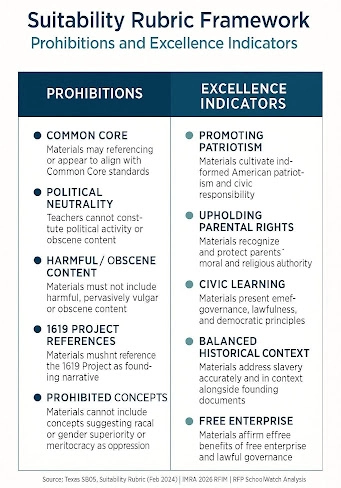
This expectation directs publishers to embed examples of civic responsibility, appreciation of democratic principles, and accurate depictions of the founding documents of the United States and Texas. Programs must present government and economic systems, such as free enterprise, as positive frameworks for understanding civic life. Reviewers look for how patriotism is woven naturally into reading selections, informational texts, and contextual passages, not as slogans, but as informed historical awareness.
The second cluster of indicators under this category introduces the content most often associated with flags. Materials must avoid advocating or implying opposing ideological positions that contradict constitutional goals. For example, any representation that diminishes free enterprise, promotes disorder or disregard of law, or romanticizes violence without context can trigger a suitability concern. According to the guidance notes in the rubric, if violence appears, it must be treated “in the context of its cause and consequence” and never for sensational or entertainment value. Similarly, discussions of civil rights movements or protests should be presented as historical examples that teach lawful demonstration and civic engagement, rather than as models for current political participation.
Perhaps the most scrutinized elements are those under TEC §28.0022, sometimes colloquially referred to as “prohibited concepts.” These provisions specify that materials must not teach or imply that one race or sex is inherently superior to another, that any individual bears guilt for past acts of their race or sex, or that meritocracy and hard work are constructs of oppression. Reviewers will flag any language, direct or implied, that can be interpreted as ideological bias or stereotyping. Publishers should review all instructional and assessment content for figurative language, word choice, and imagery that could inadvertently contradict these standards.
The exact section of the rubric prohibits the use of or reliance upon the 1619 Project or any derivative material, suggesting that the “advent of slavery constituted the true founding of the United States.” Instead, the founding must be presented in relation to the Declaration of Independence, which was adopted in 1776. This does not prohibit the honest teaching of slavery; in fact, the rubric explicitly allows for and expects materials to “honestly address the history of slavery” while ensuring it is not positioned as the sole defining feature of the American experience. The state’s goal is to strike a balance between historical truth and constitutional framing, acknowledging moral failures while upholding the enduring ideals of liberty and equality.
Another prominent category within the rubric centers on protecting children’s innocence. Here, the language draws directly from the Texas Penal Code and the Texas Health and Safety Code. Materials must be devoid of any harmful, obscene, or sexually explicit content, and they must not include material deemed “pervasively vulgar or educationally unsuitable.” Even for older grades, materials must not depict or allude to sexual conduct in a manner inconsistent with community standards or without apparent instructional necessity. Reviewers are also instructed to ensure that materials for prekindergarten through grade 3 include no references to human sexuality or reproductive health topics. Content for grades 4–12 that addresses such subjects typically presents abstinence as the preferred standard. Publishers that include wellness or health content must carefully cross-reference their lessons with these definitions to ensure they meet the expectations outlined in §28.004(e) of the Education Code.
The Suitability Rubric also introduces new and often-overlooked requirements around parental rights and political neutrality. Materials must recognize parents’ right to direct the moral and religious training of their children, a principle established in the Texas Family Code §151.001(a). Lessons, assessments, or reading passages that suggest moral relativism or that diminish parental roles in ethical or spiritual development are subject to scrutiny. Likewise, materials must not compel teachers to discuss controversial public policy issues or include assignments that involve lobbying, advocacy, or participation in political activity. Even community service or project-based learning components must be reviewed to ensure they do not inadvertently link to advocacy organizations or political movements.
These expectations may feel expansive, but they are not arbitrary. The Texas State Board of Education has deliberately aligned the suitability framework with constitutional, statutory, and community standards to create consistency across subjects and grade levels. For publishers, this means suitability compliance must begin at the product development stage, not at submission. Each department, from editorial to design, should participate in a structured suitability audit long before materials reach the TEA. Such audits should include reviewer-style “red team” readings, where independent reviewers flag potential misalignments using the rubric’s categories: patriotism, prohibited content, political neutrality, sexual content, and parental rights.
Suitability excellence indicators provide publishers with the opportunity to demonstrate alignment, rather than just avoiding rejection. Promoting patriotism can be done authentically by selecting texts that explore democratic ideals, civic responsibility, and cultural contributions that unify rather than divide. Materials that contextualize America’s historical shortcomings as catalysts for progress rather than as contradictions of its founding ideals often earn higher reviewer confidence. Similarly, including economic examples that illustrate free enterprise principles in action, such as entrepreneurship or local innovation, satisfies both educational and constitutional objectives.
In practice, excellence is demonstrated through clarity of intent. Reviewers and SBOE members seek evidence that the publisher’s program aligns with the objectives of Texas Education Code §4.001(b), specifically cultivating informed, thoughtful citizens capable of self-governance. Programs that consistently meet this expectation present complex issues in balance, treat history as a source of civic learning rather than political commentary, and demonstrate an appreciation for the state’s cultural and economic identity.
The IMRA 2026 RFIM requires that all publishers, except for those submitting supplemental mathematics programs, submit correlations to Section 2 of the Suitability Rubric to demonstrate compliance with the excellence indicators.
These correlations are due in April 2026, well before public review begins, and serve as the formal demonstration that your program has proactively addressed these requirements. The most competitive publishers treat these correlations as part of their quality review cycle, cross-referencing them with the instructional design, visuals, and assessment frameworks already being finalized under the quality rubrics.
The suitability review is not designed to limit creative expression or academic rigor; instead, it aims to strike a balance between educational quality and civic responsibility. When publishers approach suitability as an opportunity for alignment rather than avoidance, the process becomes less adversarial and more instructive. It clarifies what Texas values in its public education system: informed patriotism, parental partnership, academic objectivity, and the preservation of childhood as a protected space for learning and growth.
As reviewers begin to examine materials for IMRA 2026, the publishers who will stand out are not those who simply avoid errors, but those who anticipate expectations, viewing suitability as an extension of quality rather than its constraint. The most successful programs will be those that treat the rubric as a design document, not a checklist, and embed its principles naturally into every decision, from content selection to teacher support materials.
The “flags you don’t want to miss” are the signals of alignment that reviewers will look for when determining whether your materials embody the standards and spirit of Texas education.