
RFP SchoolWatch IMRA 2026 Guidance Series
When the Texas Education Agency released the Instructional Materials Review and Approval, or IMRA, Cycle 2026, it became clear that success would depend less on any single department and more on how well internal teams could communicate and adapt collectively. The IMRA process is not a linear submission followed by review, but a continuous cycle of feedback, revision, and recalibration. It forces publishers to work across departments with a level of discipline that even the most experienced curriculum providers often underestimate.
In every company, the first question to surface is who should lead. It seems simple enough, yet this decision becomes the defining factor in whether a team navigates IMRA with clarity or ends up caught in its current. The answer is that no one department can truly lead alone. The process demands the coordinated effort of executive leadership, product development, instructional design, marketing, accessibility, and adoption teams working as a unified system, each one anticipating the next phase and adjusting in rhythm with the others.
The executive sponsor, usually a senior leader or founder, carries the broader vision. Their job is not to manage the minutiae but to ensure that the IMRA process remains aligned to the company’s mission and growth strategy. They decide when to allocate resources, when to pause other projects to focus on IMRA deliverables, and how to communicate this shift internally so that teams understand it as an investment rather than an interruption.
From there, a designated adoption lead becomes the primary point of contact. This person functions almost like a conductor, interpreting TEA updates, anticipating reviewer feedback, and translating each new requirement into clear, actionable tasks across departments. The adoption lead is the keeper of the calendar, the crosswalk between the language of policy and the practical needs of production, ensuring that every requirement, from the publisher setup form to post-approval accessibility submissions, is completed on time and in the correct format.
The product and instructional design teams are where much of the visible work takes place, and where the intensity of IMRA is most deeply felt. These teams must complete the quality rubrics with precision, reviewing every lesson and assessment to confirm that it meets the expectations for rigor and alignment outlined in the TEKS and ELPS. There is rarely a single pass that suffices. A first review identifies surface-level issues, but a second, deeper round of evaluation ensures that instructional integrity remains intact even as materials are adjusted to meet Texas’s complex requirements. These teams become accustomed to late-night revisions, unplanned additions, and quick turnarounds, primarily due to the TEA introducing new clarifications and curveballs during the process. Even long-established publishers find themselves revisiting materials they once considered final, adding program components, or re-articulating correlations to meet the state’s evolving interpretation of quality.
Meanwhile, marketing and adoption teams carry the responsibility of translating all these internal changes into clear and coherent messaging. When program components shift or instructional design teams refine elements of a lesson, marketing and adoption leads must update outward-facing communications to ensure that districts, partners, and reviewers receive accurate and timely information. They are also responsible for maintaining consistent narratives about the product’s purpose and value, which is no small task when that product is continually evolving. The adoption process does not end when the materials are submitted; it extends into every conversation with districts and decision makers who look to these teams for confidence and clarity.
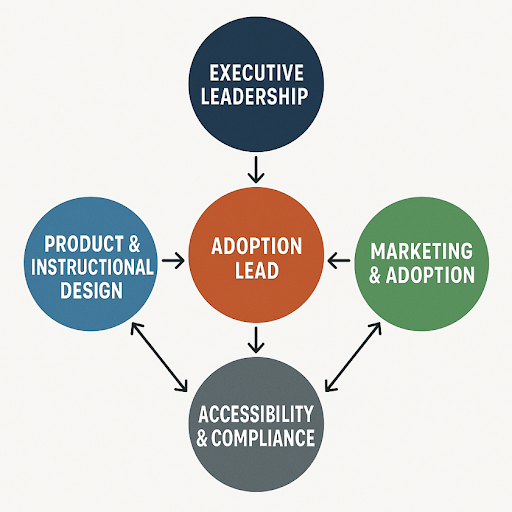
The accessibility and compliance specialists, often working quietly in the background, are in many ways the gatekeepers of approval. The TEA’s IMRA 2026 process places extraordinary emphasis on digital and print accessibility, from compliance with WCAG 2.1 AA standards to the submission of NIMAS files and the use of MathML for all mathematical notation. These specialists ensure that, regardless of how quickly the product changes, accessibility remains intact and that every revision meets the technical standards required by the Federal Rehabilitation Act and the state’s own mandates. Their work prevents last-minute disqualifications and costly delays, yet their contributions are often recognized only when something goes wrong.
The truth is that even the best-structured teams will face disruption. The TEA will issue new clarifications, reviewers will request evidence in formats that no one anticipated, and the timeline itself may shift without warning. This unpredictability is the constant undercurrent of Texas adoptions. The teams that succeed are not the ones who plan for perfection but the ones who establish communication systems resilient enough to absorb change. Regular cross-functional meetings, shared project dashboards, and transparent decision-making channels turn what might feel chaotic into a structured rhythm of response.
There is an unexpected benefit to this constant adaptation. Over time, the process strengthens the organization from the inside out. Product and design teams become sharper in their editorial judgment. Marketing and adoption staff gain fluency in compliance and policy language. Leadership learns to make faster, more strategic decisions based on real-time data. What begins as a high-pressure review cycle becomes a laboratory for improvement, one that leaves companies with cleaner workflows, clearer roles, and stronger interdepartmental trust.
Even when the outcome is uncertain, the process itself is transformative. Teams who embrace collaboration find that their materials become more rigorous, their systems more efficient, and their internal culture more cohesive. Texas has long been the most demanding market for instructional materials, but it is also the most instructive. Every company that enters this process, whether large or small, emerges with a product that is more refined, more resilient, and more attuned to the needs of educators and students alike.
Leadership in IMRA involves synchronizing multiple systems, teams, and guidance through constant change. If your teams can stay aligned through the shifting currents of IMRA 2026, they will not only withstand Texas’s rigor but also evolve because of it. That evolution, as every veteran of this process knows, is where the real victory lies.
Next in the Series: Am I Ready to Respond? A Readiness Checklist for Publishers.
Want resources in real time?