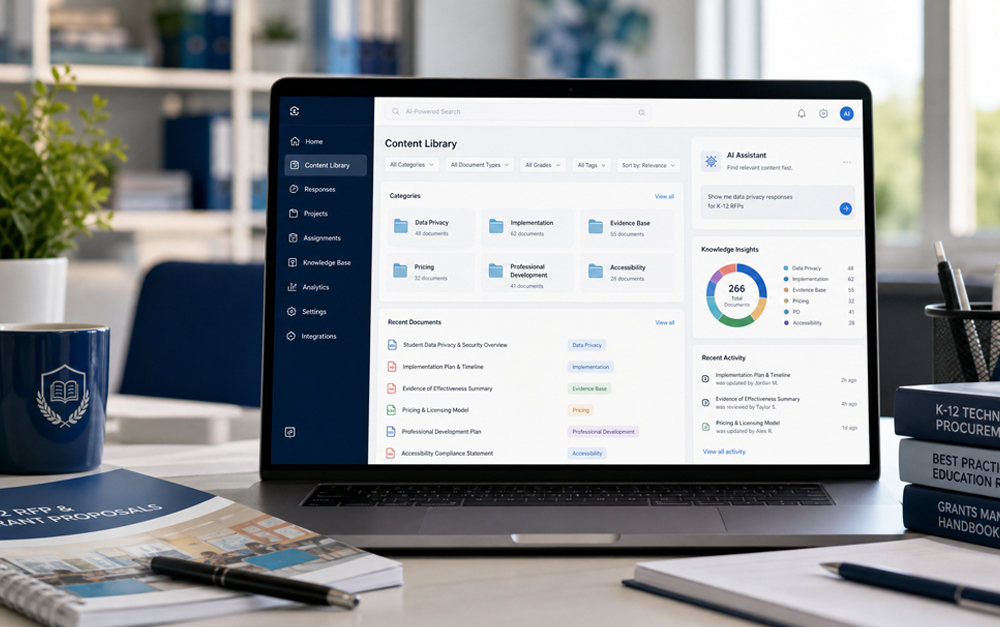

In Part 1, we looked at why traditional proposal content libraries tend to break down and what modern alternatives now exist. This post gets tactical. Here is how to build a content library your team will actually use, that stays current, and that holds up as your proposal volume grows.
Start with an Audit, Not an Organization System
The instinct when building a content library is to start organizing. Resist it. Start with an honest inventory of everything your team currently uses: saved submissions, shared drives, email threads with frequently copied paragraphs, individual writers’ personal folders.
Then ask three questions about each piece of content:
- Is it accurate today? Does it reflect current products, pricing, certifications, and relationships?
- Is it reusable? Can it be adapted across different buyers and contexts with reasonable effort?
- Is it findable? Would a writer under deadline pressure be able to locate and identify it quickly?
Content that fails the first question gets retired or flagged for immediate update. Content that fails the second or third tells you where your system design needs to do more work.
Build a Tagging Architecture That Reflects How Writers Search
Tagging is where most content libraries succeed or quietly fall apart. The mistake is building a structure that reflects how content was created rather than how it will be retrieved.
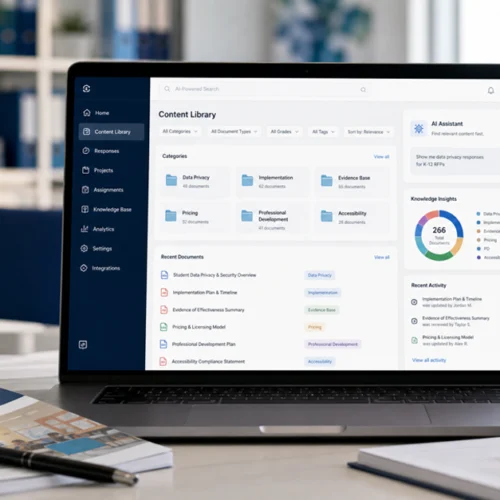
Build your primary tags around the question categories that repeat across K-12 RFPs and grants: company background, product description, implementation and onboarding, data privacy and security, evidence base, pricing and licensing, professional development, references, equity and accessibility, technical requirements. Every piece of content in your library should carry at least one.
Add secondary tags for context and filtering:
- Buyer type: district RFP, state procurement, federal grant, foundation grant, cooperative purchasing
- Audience: curriculum directors, IT administrators, finance, board of education
- Content status: current, needs review, retired
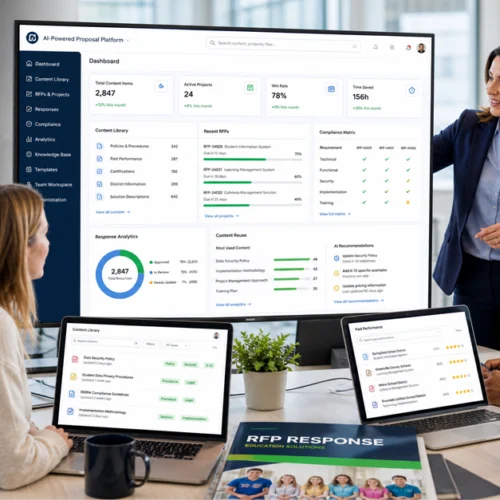
AI tools like Notion AI or purpose-built RFP platforms can analyze content and suggest tags, which is useful for large audits. The limitation is that AI-suggested tags reflect pattern recognition, not strategic judgment. A human still needs to review assignments for high-stakes or frequently reused content.
Create a tag glossary. Define what each tag means and give one example. This prevents tag drift as more people add content over time.
Optimize for Internal Search
Good tagging helps, but writers need to find content fast. The two highest-impact changes you can make:
- Write descriptive titles. Avoid generic names like 'Data Privacy Statement.' Use: 'Data Privacy Statement, FERPA and COPPA Compliance, District RFP Version.' Specific titles take ten extra seconds to write and save enormous retrieval time.
- Add short content summaries. Two to three sentences describing what the content covers, when to use it, and any important caveats. When AI tools help writers identify relevant content, they are reading these summaries. Make them informative.
Build Governance That Does Not Rely on Heroics
The governance question is where most content libraries eventually fail. Content gets added. Updates get missed. One person carries disproportionate responsibility until they leave or burn out.
Three practices that make governance sustainable:
- Assign content owners. Every piece of content should have a named owner responsible for confirming it is accurate, not necessarily for writing the updates themselves.
- Set review triggers. Some content needs calendar-based review annually. Other content needs event-based review any time your product changes, a referenced partnership shifts, or pricing is revised.
- Create a retirement protocol. Content that is no longer accurate should be retired and archived, not ignored. The goal is making sure it is never accidentally submitted in a live proposal.
The content library you maintain in February is the one that serves you in April when three RFPs land the same week. Shift some of the tedium of governance with automated task reminders.
Integrate AI Into the Workflow, Not Just the Library
The most significant shift in proposal content management is not about the library itself. AI has changed how writers interact with it. Instead of going to the library, retrieving content, and adapting it manually, writers increasingly use AI tools that pull from the library as context to generate a first draft, which the writer then refines.
If your team uses AI writing tools, document the prompts that generate strong first drafts for recurring question types. Record which context documents to include. This institutional knowledge about using AI effectively is itself a form of knowledge management worth preserving.
One governance note specific to AI: it is easy to generate content variations quickly and hard to track which version was used where. Use a simple versioning system in your library before AI tools cause your content to multiply quickly.
The Library Is the Strategy
In K-12 education contracting, where the same buyers release similar RFPs year after year, your content library is a compounding asset. Every strong response you write is worth more if you preserve it well. Every differentiator you articulate clearly becomes more valuable when you can reliably deploy it across every opportunity.
The goal is not a tidy folder structure. The goal is walking into every proposal cycle faster, more consistent, and more competitive than the last one.