
Inside an Outcomes Based Contract: What Jackson Public Schools Learned and How Providers Stand to Benefit
When Jackson Public Schools held its first pre-bid conference for an Outcomes Based Contract, the invitation was designed to do one thing: make sure every prospective vendor understood exactly what they were signing up for.
Ms. LaToya Blackshear, who oversees high impact tutoring for the 17,000-student Mississippi district, wanted vendors in the room before the RFP closed so there would be no surprises later. “Anyone who is considering entering into an OBC contract needs to fully understand the model,” she said. “They need to be prepared to be accountable.”
If a high impact tutoring vendor is bidding on an OBC, this understanding is critical because delays in the contracting process will delay the work to improve student outcomes.
A More Connected District
Jackson’s first OBC launched in 2023 with a focus on middle school math. The district identified approximately 700 students near proficiency (level 3 on Mississippi’s five-level state assessment) and set a clear target: move them to levels 4 and 5. The outcomes were measurable, tied to state assessments, and visible to everyone at the table.
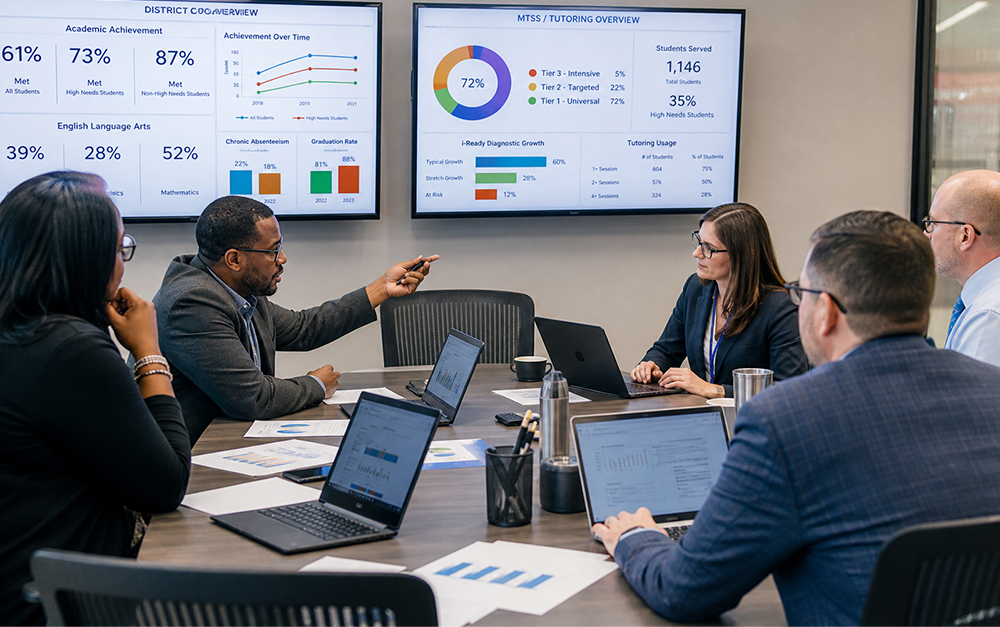
Where traditional procurement often isolated teams in silos, JPS built a cross-functional partnership that meets regularly: federal programs staff, the data lead, a coach from the Center for OBC, and assistant superintendents, all working from the same framework. That structure produces a specific kind of accountability, as well as a shared goal and vision for the work. Vendors should expect a more united front at the district, with improved communication and alignment among procurement officers, district leaders, and front-line educators.
Prepare for Weekly Conversations
By 2026, the district had added local benchmark assessments alongside the state measure. Since benchmarks create more frequent data, this means the district and the vendor are having more frequent conversations. “One of my favorite parts of OBC is to have weekly partner conversations,” Blackshear said. “Communication is first.”
If vendors are doing this right, their CSMs and district contacts should reach a “we swap voice-notes” level of comfort by the end of the school year. That kind of rapport takes intentional relationship-building, and providers should be mindful of it as they hire and assign resources.
Data Will Be Both Shared and Verified
At these weekly meetings, vendors don’t simply submit reports. Instead, both the provider and district staff bring their tracking metrics to the table and then work together to review and verify data. In such a collaborative process, both parties are able to resolve discrepancies in real time and have confidence in the information driving decisions.
“We need to discuss what each of us sees,” Blackshear said. “Ensure that all parties have the data and we review it and ensure it is aligned.” Strong partnerships require clean, consistent data and a shared commitment to transparency and continuous improvement. Vendors will need mature systems capable of tracking and reporting outcomes data, and the internal resources to handle data management and weekly reporting.
Flexibility Is a Prerequisite, Not a Feature
One of the clearest signals Blackshear offers about what separates high-performing OBC vendors from those that struggle is the willingness to change course mid-contract. “Most providers want to say ‘this is how it is, we can’t make changes,'” she observed. “You have to be willing to do that.”
The model requires real-time adjustment based on what the data shows, during the intervention itself and not at year’s end. The “tightening,” as Blackshear describes it, happens on both sides: districts adjust their support, vendors adjust their delivery, and mutual accountability sharpens the work. Vendors who arrive with a fixed program and limited appetite for adapting will find this model a difficult fit. The strongest OBC partners are those willing to adapt alongside the district and use data to continuously refine and strengthen supports for students.
On Revenue: Honest Expectations
The question most vendors are quietly carrying into these conversations is what an OBC means for the bottom line. Blackshear’s answer is candid. Like any innovative model, first-year implementation may require adjustments as systems mature and partners refine practices together. Then, as systems improve and partners hit performance targets, the incentive structure rewards the work. “The provider that is under an OBC is rewarded for high performing outcomes,” she said. Vendors who build the operational capacity to deliver and actually improve student outcomes (strong staffing, internal data systems, and genuine flexibility) will find the model works in their favor over time.
A Parting Note for Districts and Providers
For districts, the advice is straightforward: start with small programs and build systems before scaling. Make sure schedules are conducive to the dosage the contract requires, and come in already knowing how to capture, analyze, and share data, because that data drives every conversation.
For vendors, the model rewards those who build around it rather than retrofit their existing service to it. Embracing the weekly touchpoints, the data transparency, and the real-time pivots will go a long way toward finding a district genuinely invested in making the partnership work. The ones who recognize that early tend to be the ones still at the table when renewal comes around.