
Using AI in your RFP process isn’t a binary choice. It doesn’t mean either handing your proposal off to a chatbot or avoiding it altogether because it feels risky. The K-12 vendors getting the most out of AI right now have figured out something simple: not all RFP work carries the same risk, and using AI well means knowing the difference.
It starts with one distinction: the bid is public information — upload it, analyze it, mine it freely; your response is a different story. Here’s how to work in both.
Start with the bid. It’s already public.
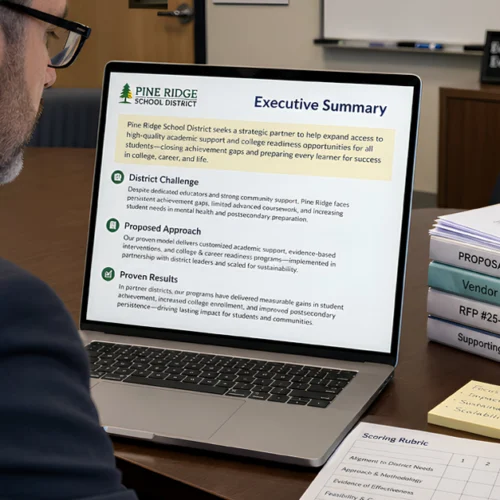
The solicitation itself is a public document. There’s no IP at risk when you put it into an AI tool. This is where AI can do some of its most powerful work. It’s also where vendors most often leave value on the table.
Use AI to decode the bid.
Always read the solicitation yourself first. And maybe even read it again. But then use AI to check your understanding. Submit a clause, share your interpretation, and ask whether you’ve got it right. It’s a fast way to confirm you’ve caught all the winning themes and requirements before you write a single word.
Take it a step further and ask AI to surface the district’s recurring language, priorities, and framing. Are they signaling urgency around a particular student population? Accountability for a specific outcome? That language belongs in your response — and AI can help you find it.
Use AI for contextual research.
When a solicitation references state standards and frameworks, district initiatives, or specific programs, you have some research to do — but don’t let that slow you down. Drop the concepts, regulations, or initiatives into AI and get up to speed fast. Understanding why criteria matter to this district is the difference between a response that feels tailored and one that could have been sent to anyone.
Use AI to map the requirements before you start writing.
Before you write a word, ask AI to build a compliance checklist from the bid. What’s required? What’s optional? What needs a signature, a notarization, a specific format? Getting this picture upfront means you’re building toward a complete response from the start and not panic-patching gaps at the end. Your AI-generated checklist is absolutely still worth double-checking — AI makes mistakes. But it gives you a solid starting point and saves you the administrative time better spent on the response itself.
Use AI to structure your response when the bid doesn’t do it for you.
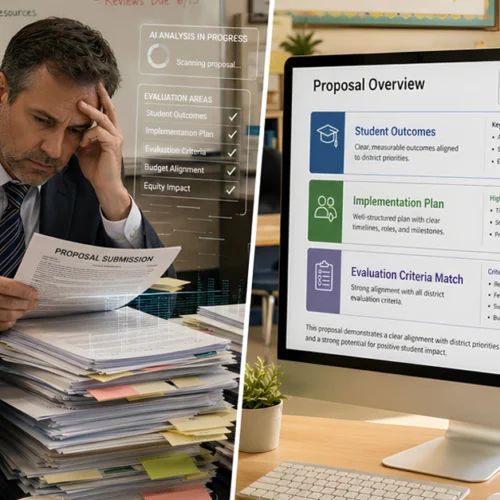
Some bids prescribe exactly how your response should be organized, but many don’t. When the format is largely up to you, there’s an opportunity to tell your story in the most compelling way, and AI can help you there. Feed in the solicitation and the scoring criteria and ask AI to suggest a response structure that maps directly to how you’ll be evaluated. A well-organized response makes it easier for reviewers to find what they’re looking for, and that matters when they’re working through a stack of submissions under time pressure.
When you move to your response, be deliberate.
When it comes to sharing with AI, your response is different than the bid. Even in draft form, it likely contains pricing, and certainly explores proprietary methodologies, client information, and competitive differentiators you’ve spent years developing. AI can still help — running a cross-section check to find where you’re repeating yourself across overlapping questions, or stress-testing your draft against the rubric the way a scorer would. But before you do either, take the time to redact what doesn’t need to be there: pricing, client names, proprietary details, even your company’s name. You’ll still get what you need without handing over your competitive edge.
The bottom line.
The bid is public. Use AI on it freely and often, as it’s one of the highest-leverage moves you can make before you start writing. Your response is yours. Protect it accordingly, and use AI in ways that make it stronger without putting what you’ve built at risk.
One distinction. One goal: a more competitive proposal with less wasted effort.