
K-12 evaluation committees are scoring more proposals than ever, and increasingly using AI-assisted tools to do it. This post breaks down how to write proposals that perform well under both human review and criteria-based scoring, with before-and-after examples across tone, jargon, outcomes language, and risk framing. Every lesson comes back to one principle: structural clarity wins.
Lessons from the Field
In K-12 procurement, evaluation committees are typically composed of cross-functional district staff—curriculum specialists, IT directors, finance officers, and building-level administrators—each scoring proposals against weighted rubrics tied directly to RFP requirements. Their job is to translate a stack of written responses into a defensible recommendation that survives school board scrutiny. Unfortunately, that job has gotten harder. The rise of AI-assisted proposal writing means evaluators are now seeing higher volumes of polished, professional-sounding submissions, many of which hit every keyword without actually saying anything. When every vendor sounds articulate, the differentiator shifts from polish to substance.
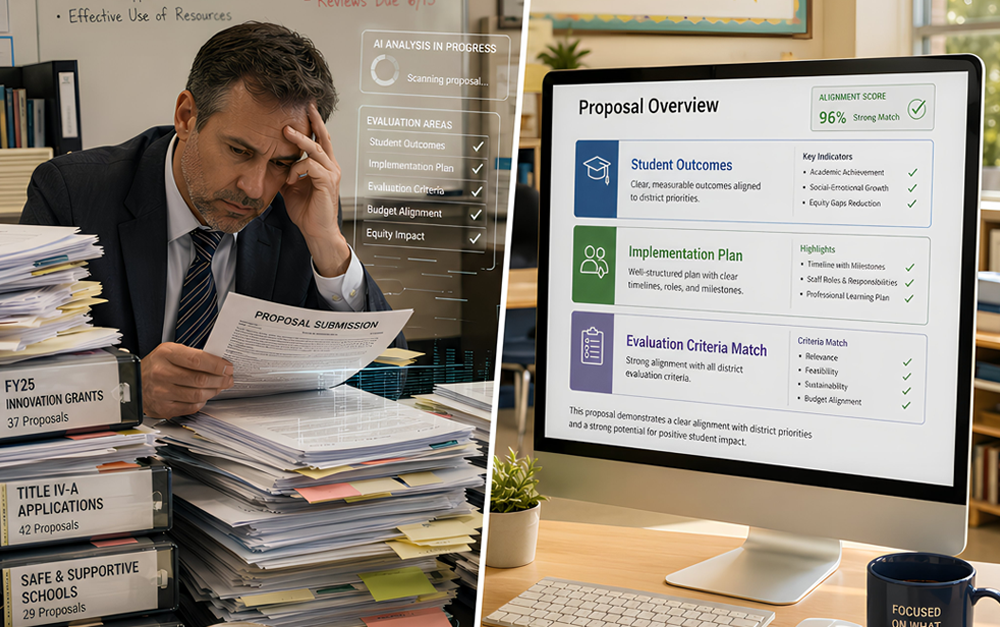
At the same time, districts are beginning to adopt AI-assisted evaluation tools that parse proposals against scoring criteria, flag gaps in compliance, and surface how directly a response maps to stated requirements. This changes the writing calculus. Proposals that bury key information in narrative paragraphs or rely on implied connections between features and requirements risk being scored lower—not because the substance isn’t there, but because it isn’t findable. The proposals that perform well in this environment are the ones written with structural clarity: explicit alignment to evaluation criteria, concrete claims that can be verified, and language precise enough for both a human evaluator and an AI-assisted review tool to score accurately.
If you are just starting out in K-12 RFPs or want to better navigate this new AI + Human world, here are 6 ways to strengthen your writing to improve clarity and ultimately, proposal scores.
1. Jargon vs. Precision
Education has its own language, and evaluators expect you to speak it. However to do so, you need to do more than just echoing RFP terminology back at the reader. Lean too heavily on ed-tech buzzwords and you sound generic; strip them out entirely and evaluators question whether you understand the sector. Instead, I recommend this: first name the education concept, then immediately translate it operationally to language that scores well whether a human or an AI tool is mapping your response to the rubric.
Before: “Our system enables differentiated instruction through adaptive learning pathways.”
After: “Teachers see real-time data on which students mastered each standard, then can assign targeted practice without manually regrouping their classroom.”
Takeaway: Write to ensure all evaluators, from AI tools to district SME’s, can score your proposal with accuracy.
2. Student Outcomes First
As a vendor, it is tempting to focus on descriptions of features of our product or service. The school system, however, is weighing one question: Does this help more students learn? This is the metric that determines whether a principal gets renewed, whether a district keeps its funding, and whether the next technology initiative gets greenlit or shelved. Proposals that win connect your solution’s capabilities back to student time and learning in terms that are concrete enough to survive a scoring rubric.
Before: “Our platform streamlines the attendance tracking process with an intuitive digital interface.”
After: “Our platform reduces attendance entry time by 12 minutes daily, giving teachers time back for small-group interventions with struggling readers.
Takeaway: The first describes a feature. The second describes a business outcome an evaluator can defend to her school board.
3. The Tone That Builds Trust
K-12 evaluators have developed a finely tuned filter for sales language. What lands is a conversational, grounded tone that acknowledges the realities they navigate. While districts are facing limited IT staff, competing priorities, and budget constraints that force hard choices, your proposal must speak to these operational realities to read as both credible and scorable.
Before: “Our flexible deployment model accommodates phased implementation across diverse district environments.”
After: “Implementation happens in phases because districts can’t swap entire systems in August. We start with two pilot schools, then scale after winter break.”
Takeaway: Write as a partner and expert on the work, not just a sales expert on a product.
4. Reality-Based Consequences Over Hype
A bad ed-tech implementation destabilizes classrooms mid-year, erodes teacher trust, and makes the next initiative exponentially harder to launch. Evaluators carry that institutional memory, which is why glossy promises will not score any points. Proposals that name the risks and show built-in safeguards earn credibility that holds up under both human judgment and criteria-based AI review.
Before: “We ensure successful implementation through our proven onboarding methodology and dedicated support team.”
After: “We know a failed rollout costs you staff morale and instructional time. That’s why we start with early adopters, then expand only after 60 days of stable usage and documented teacher feedback.”
Takeaway: Evaluators trust vendors who name what can go wrong and show how they’ve planned for it.
5. Knowledge Without Hiding Behind It
Education proposals need to demonstrate sector knowledge. An evaluator who reads a proposal conflating MTSS with RTI will assume the vendor doesn’t get the space. But your evaluator’s committee likely includes people who don’t all speak ed-tech fluently, and an AI-assisted scoring tool won’t infer what you meant from context. A proposal that locks out non-experts loses the entire committee.
Before: “Our platform supports MTSS frameworks through tiered intervention protocols aligned to evidence-based practices.”
After: “The dashboard flags at-risk students by week three of the school year so intervention teams can act while there’s still time to change a student’s trajectory.”
Takeaway: Use terminology accurately, then translate it into what it means for the people doing the work.
6. The Real Win
Writing for education evaluators today means writing for a dual audience: the human committee member scanning for substance and the AI-assisted tool parsing for alignment. Both are looking for partners who understand the district’s world, speak to constraints honestly, and articulate how solutions improve teaching and learning with supportive evidence.
Takeaway: Make every claim explicitly traceable to the evaluation criteria. Proposals written with this kind of structural clarity build confidence long before the contract is ever signed.