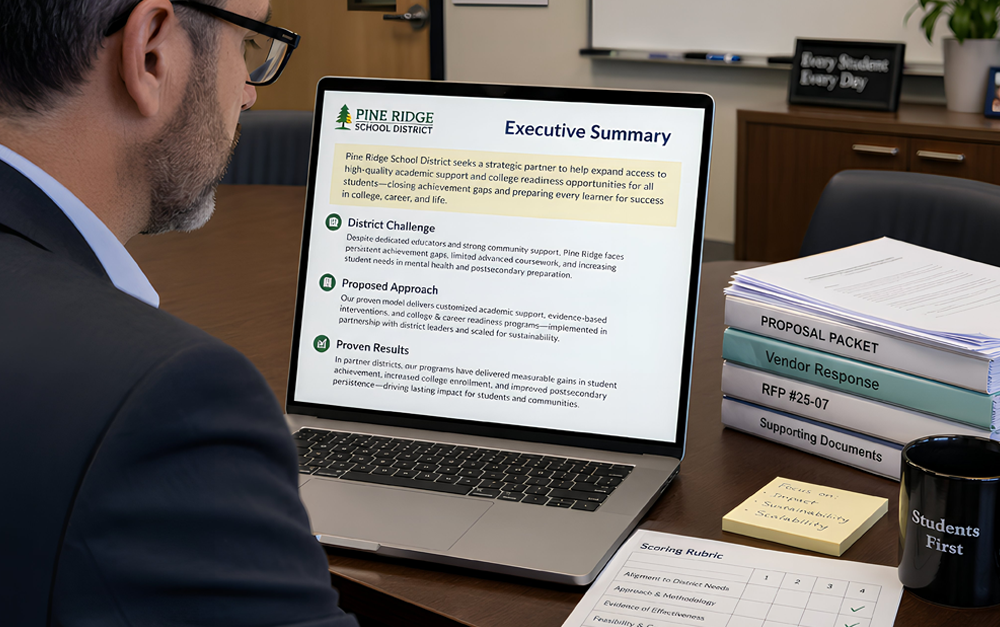

The executive summary is the highest-stakes section of any education RFP response, and most vendors waste it on boilerplate. This post walks through how to structure an executive summary that leads with the district’s problem, aligns to the scoring rubric, and builds evaluator confidence before they turn the page.
I have seen so many education RFP responses open with a basic paragraph about the company. “Founded in 2012, headquartered in Austin, passionate about student outcomes. ”The evaluator skims it, learns nothing useful, and moves to the next section. That opening cost the vendor the one moment where they had the reader’s full attention.
The executive summary is the only section every evaluator reads completely. In a stack of proposals, it is the section that sets the framework for everything that follows. A strong executive summary builds momentum that carries through the technical approach, staffing plan, and pricing. A weak one means the evaluator is already skeptical (or worse – has written the proposal off) before they reach page three.
Start with Their Problem, Not Your Story
The most effective executive summaries open by reflecting the district’s challenge back to them in specific, recognizable terms. This signals that you read the RFP carefully and understand the context behind the procurement. Vendors can draw the evaluator’s attention by naming their actual situation rather than offering a generic solution pitch.
- Executive Summary Opener: Name the district’s specific challenge + Preview how the solution connects to that challenge.
Generic: “ABC Learning is an industry-leading provider of K-12 tutoring solutions with over 15 years of experience serving school districts nationwide.”
Tailored: “Clark County USD has seen chronic absenteeism rise 14% since 2021, concentrated in Title I middle schools where academic intervention capacity is already stretched thin. ABC Learning’s proposed tutoring model is designed to close that gap without adding burden to existing intervention staff.”
The second version uses a strong structure that lets the evaluator know immediately that the vendor did their homework.
Structure Around Three Questions
Strong executive summaries in education RFPs answer three questions in roughly this order:
1. What is the district trying to solve?
2. How does your approach address it?
3. Why should they trust that you can deliver?
Keep this structure tight to prevent the common drift into product features or company history that will dilute the section’s impact.
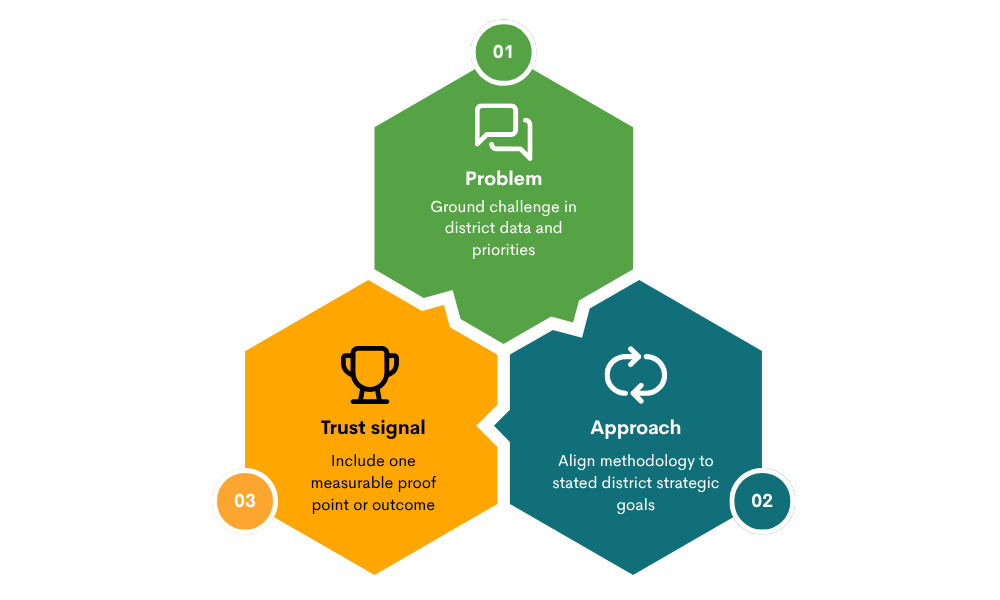
- The problem should take about a third of the space. Ground it in data from the RFP, the district's strategic plan, or publicly available performance metrics.
- The approach is where we connect our methodology to the district's priorities without getting into granular technical detail. Save that for the technical section.
- The trust signal is a brief proof point: one relevant implementation, one measurable outcome (ESSA ratings and research study outcomes are a great choice), or one indicator that we've done this work before in a similar context.
Test: Identify a single clear theme running through the executive summary. If that isn’t possible, then the structure needs tightening. (Hint: Return to the 3 questions above).
Write to the Scoring Rubric
Many education RFPs publish their evaluation criteria or scoring rubric, and the executive summary should be written with those categories in mind. If the rubric weights “understanding of district needs” at 20 points, the opening paragraph should make it unmistakable that we understand their needs. If “prior experience with similar districts” carries 15 points, the proof point should speak directly to that criterion.
This doesn’t mean we structure the executive summary as a checklist of rubric items, however. Instead we make it so that the evaluator, rubric in hand, can find the evidence for their highest-weighted categories without hunting for it. The goal is to make it easy for them to give us points.
Generic: “We have extensive experience working with school districts of all sizes across the United States.”
Tailored: “Over the past three years, we’ve implemented this model in four Title I districts with enrollment profiles similar to Clark County, including a 2023 deployment in Mesa USD that improved math proficiency rates by 11 percentage points within two semesters.”
Keep It to One Page
Unless the RFP specifies otherwise, aim for a single page. Executive summaries that run long usually contain material that belongs in other sections. If the executive summary includes implementation timelines, staffing models, or detailed feature lists, pull those out. This is a strategic overview, not a condensed version of the full proposal.
Test: Read the executive summary aloud. If it takes more than 90 seconds, it’s probably too long.
The Real Advantage
The executive summary is a small section that carries outsized weight. When the opening section demonstrates a clear understanding of the district’s challenges, a thoughtful approach to solving them, and credible evidence of past success, the evaluator carries that confidence into the technical sections, the staffing plan, and the pricing. Getting it right means doing the upfront work: reading the strategic plan, pulling the performance data, and choosing the proof point that mirrors this district’s reality. That preparation shows on the page, and evaluators reward it.
In Part 2 of this series, we’ll dive deeper into the proof points and past performance elements that make executive summaries credible and give evaluators the evidence they need to defend their scores.