
Most K-12 proposal teams treat pricing as a formality: a number in a table, a tab in the response. Experienced teams know it is one of the highest-leverage decisions in the entire proposal process. This post covers how to approach pricing model selection, strategy, and market research in a way that holds up under evaluation.
Proposal Pricing Strategies: What the Market Will (and Won't) Tell You
Pricing an RFP response for a K-12 district is one of the places where proposal teams often underinvest their thinking. The number goes in a table, the table goes in the response, and the team moves on. The strategy that should sit behind that number and the research that makes the strategy defensible, however, gets skipped.
Here’s how experienced proposal teams approach it.
Know Which Pricing Model You're Working With
Before any numbers get discussed, they have identified the model. Education and EdTech vendors selling to districts typically work within four structures: per-student or per-user pricing, per-site or per-school pricing, district-wide enterprise pricing, or module-based pricing where a base platform carries optional add-ons.
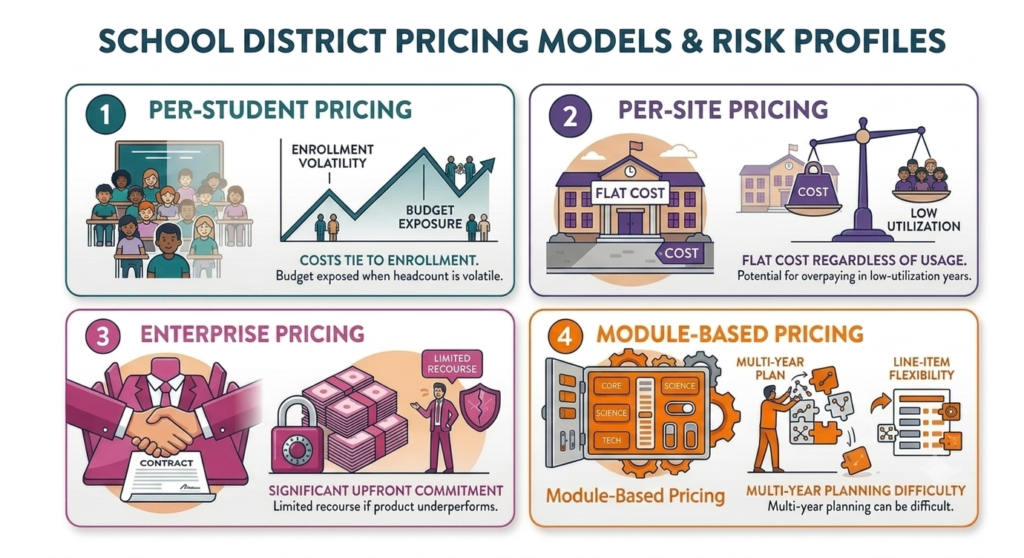
Each model carries a different risk profile for the district. Per-student pricing ties costs directly to enrollment, creating budget exposure when headcount is volatile or difficult to forecast. Per-site pricing locks in a flat cost regardless of how many students actually use the product, which can mean overpaying in low-utilization years. Enterprise pricing demands a significant budget commitment upfront, with limited recourse if the product underperforms or the vendor relationship shifts. Module-based pricing offers flexibility at the line-item level but can make multi-year budget planning difficult to hold together.
Knowing which model a district prefers, and why, shapes how the proposal presents cost from the first line. That conversation happens before the response goes to draft, not after.
Choose a Pricing Strategy, Not Just a Price
Three approaches dominate K-12 Education and EdTech proposals: cost-plus, value-based, and competitive. Teams that have been through enough evaluation cycles know the difference between choosing a strategy and defaulting to one.
Cost-plus starts with internal costs and adds margin. It protects profitability and works well for customized engagements with known scopes, but it can land a vendor outside the competitive range if the market has moved.
Value-based pricing anchors the number to outcomes rather than inputs. When a vendor can point to measurable student achievement gains, reduced intervention costs, or time savings for staff, the price becomes a function of what the district gets rather than what the vendor charges. This approach requires strong proof of value, including efficacy data, case studies, and outcome metrics, but it is also the most defensible position in a competitive evaluation.
Competitive pricing sets the number relative to market alternatives. It works in highly contested procurements but carries real margin risk if vendors race toward the floor.
The strongest proposals often blend approaches: lead with value justification, validate against market rates, and protect margin through multi-year commitment structures. That blend does not happen by accident. It is the result of a deliberate pricing conversation early in the capture process.
Use Research to Know Where the Market Actually Is
Guessing at market rates is risky. Experienced teams collect a meaningful sample of comparable contracts, normalize the pricing to a common unit such as per student, per site, or per year, and identify the range. From there, the question becomes positioning: where does this vendor’s solution sit relative to the market, and what justifies that position?
Several tools now exist, both paid and publicly available, to aggregate historical government purchasing data, including K-12 contract awards, that let proposal teams benchmark against real transactions rather than assumptions.
District procurement history is worth mining beyond contract amounts as well. School board minutes and budget discussions, available through public records and education-focused research tools, often surface what a district actually prioritized in prior vendor selections. Teams that do this work understand how to frame price relative to what evaluators actually care about, not what the vendor assumes they care about.
Make the Price Earn Its Place
Since a number without justification is just a number, winning teams apply two strategies to validate their pricing. Value-based justification connects price to outcomes the district cares about: reading level gains, teacher time recovered, intervention costs avoided. Competitive justification positions price relative to market benchmarks and total cost of ownership, not just the annual subscription fee, but implementation, training, integration, and ongoing support.
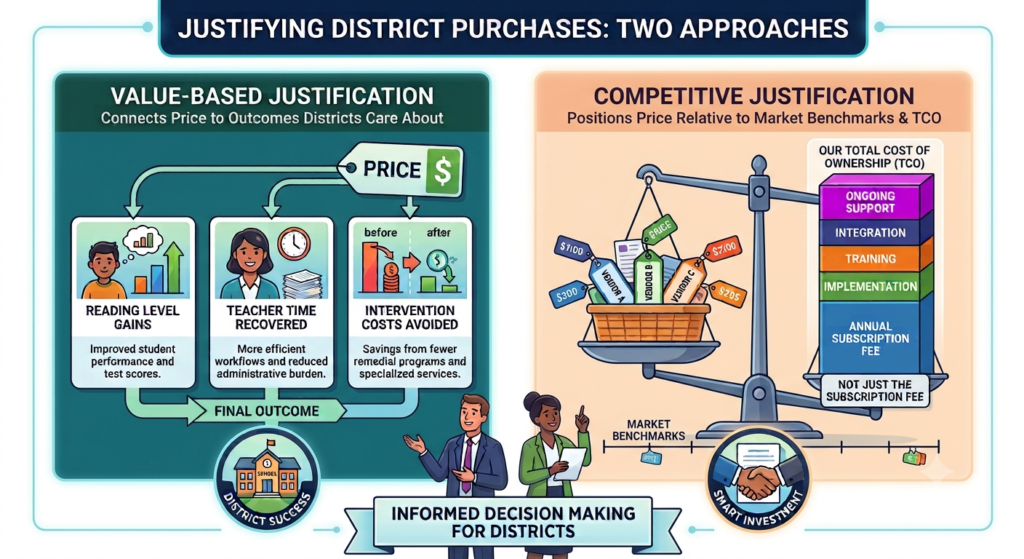
The most effective pricing sections in K-12 proposals do both. They establish that the price is reasonable relative to the market and worth paying relative to the results. Vendors who treat the pricing section as a formality leave evaluators to draw their own conclusions, and those conclusions are rarely in the vendor’s favor.
Experienced teams understand that the pricing section is not simply where cost gets recorded. It is where the case for value gets made.