

In Part 1, we covered the structure that makes an executive summary work: leading with the district’s problem, organizing around three core questions, writing to the scoring rubric, and keeping it to one page. Now we’ll dig into evidence – the proof points and past performance references woven into an executive summary are what transform a well-organized proposal into one that builds genuine confidence.
This post is a quick-reference guide for selecting, framing, and placing proof points that do the most work in the least amount of space.
What Makes a Proof Point Land
The strongest proof points combine a measurable outcome with recognizable context. “We improved reading scores” is a claim. “Third-grade reading proficiency at Jefferson Elementary increased 9 percentage points over one academic year during our pilot” is a proof point. The difference is specificity. When a proof point names a real context and a measurable result, evaluators can map it onto their own schools and see the potential.
Use this checklist to evaluate whether a proof point is strong enough for the executive summary:
Proof Point Strength Checklist
- Is the outcome quantified? (Percentages, timeframes, or counts)
- Is the context specific? (Named district type, grade band, or student population)
- Is it recent? (Within the last 3 years for most education procurements)
- Is it relevant to this RFP? (Similar district size, demographics, or challenge)
- Can you verify it if asked? (Reference contact, published data, or case study)
- Does it connect to a priority in the scoring rubric?
Choosing the Right Past Performance Reference
Vendors likely have multiple implementations they could reference. In fact, I recommend creating a database of case studies and overviews for each type of program offered. The right one for the executive summary is the one that most closely mirrors the district issuing the RFP. Evaluators are seeking relevant examples, and they want to see that you’ve succeeded in an environment that looks like theirs. A suburban district with 15,000 students will have far more confidence in a vendor who provides a reference from a similarly sized district than from a 200,000-student urban system, no matter how impressive that larger engagement was.
Past Performance Selection Matrix
Rank your references against these criteria. Use the one that scores highest for this specific RFP:
- Similar enrollment size (within 25% of the target district)
- Similar student demographics (Title I percentage, ELL population, urban/rural)
- Same solution (tutoring, SIS, curriculum, assessment, etc.)
- Similar implementation scope (district-wide vs. pilot, number of schools)
- Comparable timeline (full school year, summer program, multi-year contract)
- Referenceable contact who will speak positively if called
Framing Metrics That Evaluators Trust
Not all metrics carry equal weight in education procurement. Student outcome data is the gold standard because it connects directly to the evaluator’s accountability framework. Operational metrics (time saved, adoption rates, teacher satisfaction) support the narrative, but they rarely carry a proposal on their own. The strongest executive summaries lead with a student outcome and follow with an operational metric that explains how it was achieved.
Weaker: “95% of teachers reported satisfaction with our platform after the first semester.”
Stronger: “Students using the platform three times per week showed a 12-point gain on district benchmark assessments, with 95% teacher adoption sustained through year-end.”
The second version is anchored in student results and uses the teacher adoption rate as supporting evidence for sustainability, which gives evaluators confidence that the outcome is repeatable.
Quick-Reference: Executive Summary Proof Point Formula
When space is tight, use this structure for each proof point:
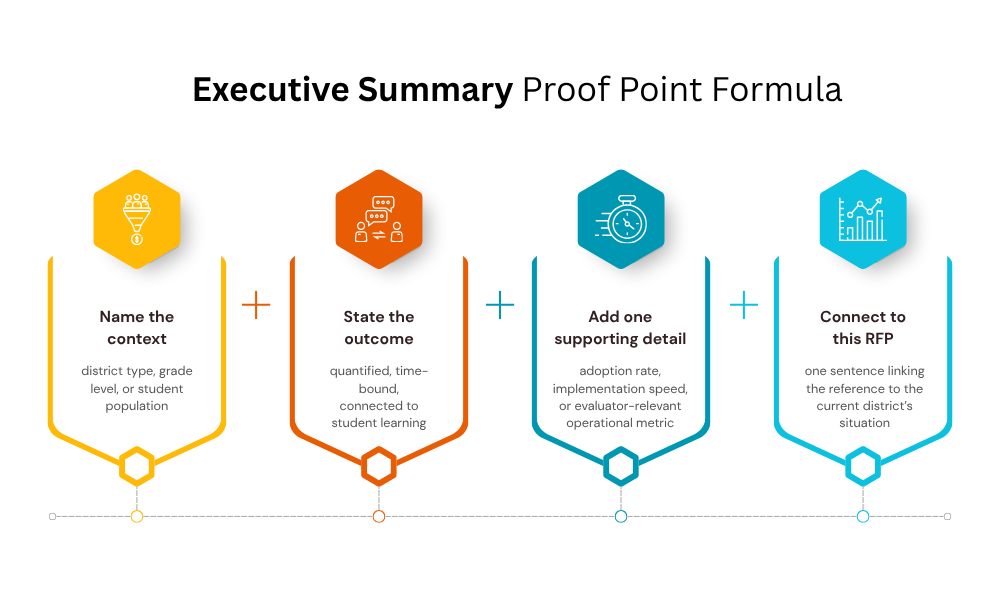
1. Name the context (district type, grade level, or student population)
2. State the outcome (quantified, time-bound, connected to student learning)
3. Add one supporting detail (adoption rate, implementation speed, or evaluator-relevant operational metric)
4. Connect to this RFP (one sentence linking the reference to the current district’s situation)
Putting It Together
The executive summary is where evaluators form their first real impression of credibility. Structure orients them; proof points convince them. By selecting references that mirror the district’s context, leading with student outcomes, and making every metric verifiable, we make it easy for the evaluator to award us maximum points from the rubric.
Remember that evaluators who recommend a vendor will also have to defend that recommendation to a purchasing committee, a superintendent, and/or a school board. Strong proof points give them the language to do that. When we pair the structural framework from Part 1 with evidence that is specific, relevant, and verifiable, we make it easy for the right evaluator to champion our proposal in the room where decisions get made.