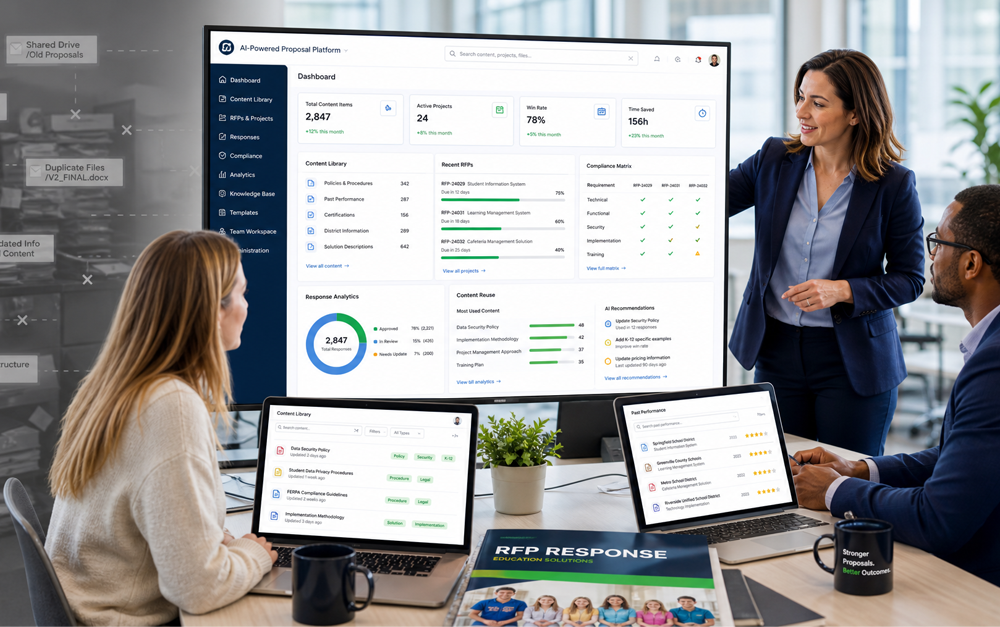

Most K-12 proposal teams are working from an inherited content model that was never designed to scale. Part 1 breaks down why it fails and what modern alternatives now make possible.
Building Your Education Proposal Content Library: Content Libraries and Their Alternatives
If you have been in K-12 edtech sales or proposal management for more than a few years, you have probably lived through at least one version of the shared folder nightmare. There is a Google Drive folder called something like ‘Proposal Content FINAL v3 USE THIS ONE.’ Inside: a mix of capability statements, outdated case studies referencing a pilot that ended two years ago, and at least one piece of evidence nobody can source but nobody wants to delete.
I’ll admit, in my early days of RFP writing I relied on something similar. But alas, this is not a content library my dear colleagues. Simply an archive of documents that will lose relevance before you can say “final final final draft.”
The gap between those two things is what this two-part series is about. Part 1 looks at how proposal content management has traditionally worked, why it tends to break down, and what modern alternatives now exist. In part 2 we’ll get more tactical with the actual building blocks of content management.
The Inherited Model and Why It Breaks Down
For many organizations, proposal content management still looks something like this: a shared drive organized by someone who no longer works there, boilerplate living in email threads, one or two people carrying the real knowledge in their heads, and a lot of copying from the last winning response.
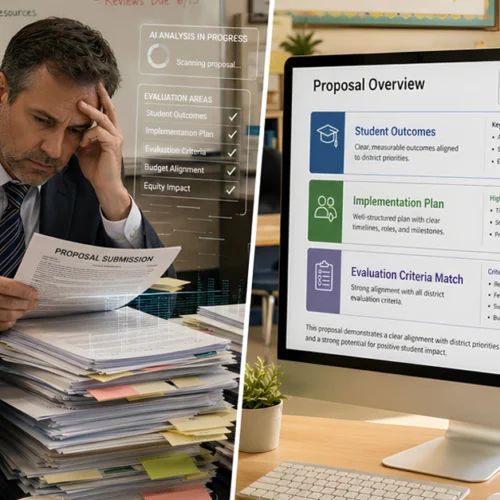
This might suffice when teams are small and submission volumes are low. The problems surface when teams grow, staff turns over, or RFP volume spikes. Institutional memory fragments or walks out the door. SME’s constantly rewrite content with low trust scores. Version control is saving a final_final copy on your desktop. Quality assurance is a reviewer having a bad feeling about a paragraph they cannot quite place.
Three structural failures drive most of these breakdowns:
- Libraries built for storage, not retrieval. Content is organized around how it was created, not how writers search for it under deadline pressure.
- Outcome → Writers default to their own files or last year's submission.
- Version control that is manual and fragile. Pricing tables, compliance statements, and case studies go stale because updates depend on someone remembering to make them.
- Outcome → Outdated language makes it into live submissions before anyone catches it.
- Governance treated as an afterthought. Without clear content ownership, libraries become collective attics where things go in but rarely come out.
- Outcome → When the person carrying institutional knowledge leaves, whatever coherence existed in the attic leaves with them.
The inherited library will fail not due to lack of effort, but from its missing infrastructure.
What AI Has Changed
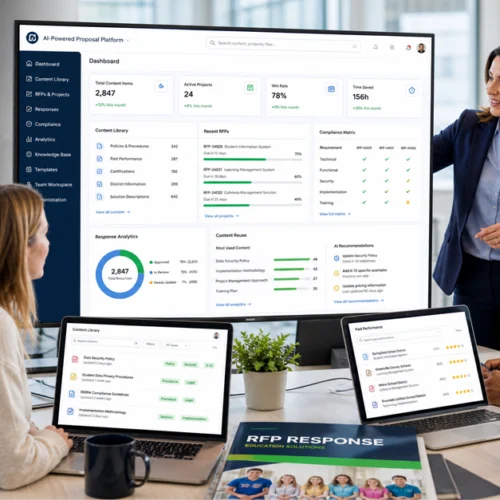
Library capabilities have been completely overhauled by tech advances over the last two or three years. Modern AI-enhanced knowledge management tools have changed what it means to find something. Writers can search by concept, theme, or outcome and get usable results in seconds. When retrieval is fast, writers actually use the library. When writers use the library, content stays more current. The whole system reinforces itself.
Version control has shifted too. Many modern platforms connect directly to where your content already lives — product pages, marketing copy, org charts, internal wikis — so updates flow through without manual copying. Some tools also flag content that may be outdated based on changes elsewhere in your organization, or alert you when a piece has gone too long without review. The responsibility for keeping content current does not disappear, but the system now helps carry it.
Governance is the one failure AI does not solve on its own. Content ownership, review accountability, and retirement protocols still require human decisions and human structure. Part 2 covers how to build that layer in a way that holds up over time.
Alternatives Worth Knowing
For smaller teams or organizations earlier in their content maturity, a full-scale library may not be the right starting point. Lighter-weight alternatives can serve the current moment without significant infrastructure investment:
- Modular response banks: Organize by question type rather than document. Build and maintain answers to the most common RFP questions as atomic, updatable units.
- AI-ready content packs: A curated set of source documents (boilerplate, case studies, pricing summaries, org facts) formatted for easy use with AI drafting tools. When your grounding content is clean and current, AI output requires far less correction.
- Compliance matrices as living documents: A running matrix that tracks your standard responses to recurring K-12 requirements functions as a lightweight library focused on high-value content.
- Notion or Airtable-based systems: Both have become viable content management options for small to mid-size proposal teams, especially when paired with tagging and filtering workflows.
The Core Argument for Reusable Content
Whatever system you use, the value proposition rests on one idea: reusable content. Not recycled boilerplate copy-pasted without thought, but strategically developed content that can be adapted to context without being rebuilt from scratch.
In K-12 education contracting, this matters more than in almost any other sector. You are often responding to dozens of similar RFPs across districts and states. The buyers want to know the same things: your implementation model, compliance record, evidence base, and the outcomes you can achieve. Rebuilding those answers from scratch every time creates drag on your team and introduces quality inconsistency with each new proposal.
With a functioning content library, however, your team’s best work is the baseline.
Next week in Part 2: Building Your Education Proposal Content Library, we move from diagnosis to build. We cover tagging, search optimization, governance, and how AI fits into the workflow.