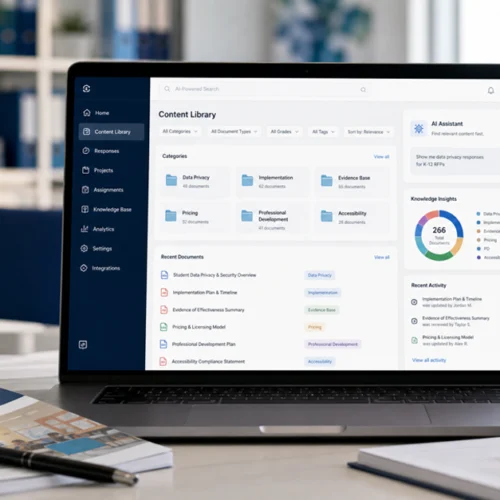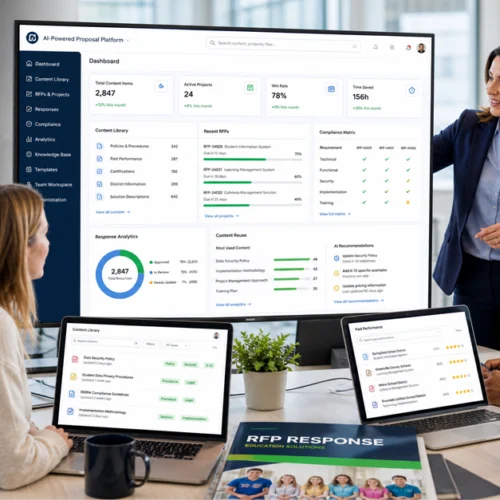

Procurement teams screen for compliance first. Fail the mandatory requirements and vendors are disqualified before anyone even reads the technical approach. Once vendors pass the gate, evaluators then pass proposals along to subject matter experts who assess cost, innovation, and implementation quality.
The distinction of these evaluation stages matters: the compliance matrix answers “Can this vendor meet our requirements?” while the narrative responses answer “Will this vendor execute excellently?” Both questions must be answered, but they are evaluated in sequence and compliance always comes first.
Meeting Requirements vs. Exceeding Expectations
While baseline compliance gets you through the first gate, differentiation scores the contract.
Let’s consider how K-12 evaluators might score these scenarios:
| Requirement | Baseline Response | Differentiated Response | Score Impact |
|---|---|---|---|
| Training | We will hold 2 days of onsite training post-implementation. | We will provide 4 days of tiered training for teachers, admins, and IT staff, plus monthly virtual office hours for 6 months. We will also provide a dedicated training portal with recorded modules. | Demonstrates understanding of varied skill levels and commitment to sustainability |
| Integration | Our platform integrates with Google Classroom API. | Our solution integrates with Google Classroom, Google Workspace identity management, and Google Meet for virtual instruction—reducing IT burden by automating SSO. | Solves problems clients didn't explicitly ask for; signals deeper thinking |
| Security | We follow FERPA compliance standards. | We hold FERPA certification, conduct annual third-party audits, encrypt all student data at rest and in transit, and maintain SOC 2 Type II compliance. | Demonstrates rigor beyond what was asked |
The K-12 Evaluation Lens
K-12 evaluators play by different rules than government or corporate buyers. Student safety is non-negotiable, teachers are already juggling dozens of responsibilities, and their funding comes with strings attached from federal, state, and local sources that each have their own requirements. If we miss these details we leave points on the table. For example:
Regulatory stack awareness: FERPA, IDEA, ADA, and state-level requirements—K-12 evaluators scrutinize all of it. If missing, these mandatory requirements don’t just impact a proposal’s score, the solution is flagged as noncompliant.
Realistic Implementation: Do vendors actually understand their world and the realities of understaffed IT departments, limited bandwidth, and mixed device chaos? A proposal that shows understanding will score significantly higher. For example: “Recognizing the district’s limited IT staff, we provide a managed service model with automated reporting, reducing your administrative burden.”
Sustainability: K-12 districts know that solutions designed with long-term support baked in fare better. The proposal should mention ongoing support, training refreshes, and maintenance to reassure reviewers that implementation support does not disappear after go-live.
Student outcomes: Once through the compliance gates, the evaluators focus shifts to how your solution impacts student outcomes. Proposals should make it easy for reviewers to connect the dots without making them do mental gymnastics. For example, “This data dashboard helps teachers identify at-risk students faster, improving intervention timing and graduation rates” beats “this dashboard tracks student progress.”
Budget predictability: District budgets are inflexible, therefore proposals showing crystal-clear, locked pricing and transparent cost structures beat those with surprises lurking in the fine print.
Know What Matters Most
- Compliance: 40%
- Technical approach: 35%
- Cost: 15%
- References/experience: 10%
This checklist can be used before every submission. I suggest turning into a template in your project management tool. Check every box, every time. This is the final quality gate.
- Does each response directly tie to the requirement?
- Is the response location (section/page number) explicitly stated in both the matrix AND the proposal?
- Are compliance responses buried in narrative? If so, pull them out and make them visible.